

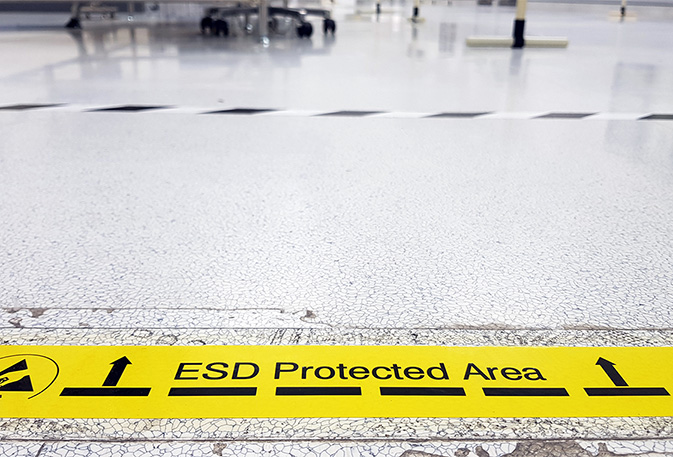
What Is ESD Flooring and Does Your Commercial Space Need It?
If you work in an industry where static electricity can damage equipment, compromise safety, or disrupt sensitive processes, you've likely heard the term ESD flooring. But for many business owners and facilities managers, the details remain fuzzy — what exactly is it, who actually needs it, and what does installation look like? Here's a straightforward breakdown.
What Is ESD Flooring?
ESD stands for Electrostatic Discharge. It refers to the sudden flow of electricity between two objects with different electrical charges — the same phenomenon as a static shock when you touch a doorknob, just with potentially far more serious consequences in the wrong environment.
ESD flooring is a specialized coating or surface system designed to safely control, dissipate, or ground static electricity before it can build up to a damaging or dangerous level. Rather than allowing a charge to accumulate on people or equipment moving through the space, an ESD floor continuously channels that energy safely away.
These floors are engineered to meet specific electrical resistance standards — typically falling into one of two categories: electrostatic dissipative (ESD), which slows the discharge to a controlled rate, or conductive, which routes the charge to ground immediately. Which type is appropriate depends on the specific sensitivity of your environment.
Who Needs ESD Flooring?
Not every commercial space requires it, but for certain industries it's not optional — it's a functional and sometimes regulatory necessity.
Electronics manufacturing and assembly is the most common application. A single uncontrolled static discharge can permanently damage microchips, circuit boards, and sensitive components in ways that aren't always immediately visible. ESD flooring is standard practice in these environments.
Data centers and server rooms house equipment that is highly vulnerable to static damage. The combination of raised flooring systems and ESD coatings is a recognized best practice for protecting infrastructure worth hundreds of thousands of dollars.
Medical device and pharmaceutical facilities often require ESD flooring to protect both sensitive equipment and, in some cases, to prevent static ignition near flammable compounds or gases.
Aerospace and defense manufacturing involves components and assemblies where static damage can have serious downstream safety consequences. ESD flooring is frequently specified in these environments by both internal standards and government contracts.
Automotive and industrial paint booths can accumulate dangerous static charges around flammable materials. Conductive flooring in these environments is as much a fire and explosion prevention measure as it is an equipment protection strategy.
What to Expect During Installation
ESD flooring installation follows a similar process to standard epoxy or polyaspartic systems, with a few critical additions.
Surface preparation is just as important here as in any coating application — the concrete must be properly ground and profiled for the coating to bond correctly. Any compromise in prep affects both adhesion and the floor's electrical performance.
Copper grounding strips are embedded in or beneath the coating system and connected to a verified ground point. These are what actually complete the circuit and allow the floor to do its job. The layout and placement of grounding strips is planned in advance based on the size of the space and the traffic patterns within it.
The coating system itself is applied in layers — a base coat formulated with conductive or dissipative properties, followed by a topcoat that provides surface durability while maintaining the required electrical resistance range.
Resistance testing is performed after installation and documented. Most ESD specifications require the finished floor to fall within a defined resistance range — typically between 1 x 10⁶ and 1 x 10⁹ ohms for dissipative floors, or below 1 x 10⁶ ohms for conductive. A proper installation includes this verification as a deliverable, not an afterthought.
The timeline is comparable to a standard commercial coating project — typically one to two days for a modest-sized space, depending on square footage and complexity.
The Bottom Line
ESD flooring is a purpose-built solution for environments where static electricity poses a real risk — to equipment, to product quality, or to safety. If your operation falls into one of the industries above, it's worth a conversation with a qualified flooring installer about whether your current floor is meeting the standard your work demands.
Organized Garage installs ESD and conductive flooring systems for commercial and industrial applications. Contact us to discuss your facility's requirements and get a free estimate.